Why Your Order Quantity Decides the Customisation Technique Before Your Procurement Team Does
Every quarter, I receive at least three or four enquiries that follow the same pattern. A procurement manager contacts our factory with a clear brief: they need 150 to 200 branded leather notebooks for a client appreciation event, and they want blind debossing on the cover with a custom ribbon marker colour. The product category is correct for the occasion. The specification sounds reasonable. The budget per unit is within a normal range for that tier of gift. And yet, within the first ten minutes of the conversation, I already know that the order as described cannot be produced at the quoted specification—not because the factory lacks capability, but because the order quantity does not meet the minimum threshold required for the customisation technique the client has assumed is included in the unit price.
This is a structural problem in how corporate gift procurement operates, and it is one that surfaces repeatedly in the gap between catalogue presentation and production economics. When a procurement team evaluates corporate gift options—notebooks, pen sets, desk accessories, presentation folders—the product catalogues and supplier websites they review present the finished product at its maximum specification. The notebook is shown with a beautifully debossed logo, a custom Pantone-matched cover, a foil-stamped spine, and a bespoke ribbon marker. The pen is displayed with laser-engraved branding, a custom barrel colour, and a presentation case with a magnetic closure. These are real products that the factory genuinely produces. But they are produced at quantities that justify the tooling, setup, and material sourcing costs embedded in each customisation technique. The catalogue does not show which techniques are available at 100 units, which require 500, and which only become economically viable at 3,000. The procurement team sees the finished product and assumes that their order—regardless of quantity—will receive the same treatment. The factory receives the enquiry and begins the process of explaining which elements of the specification must be downgraded, substituted, or eliminated to make the order viable at the requested quantity.
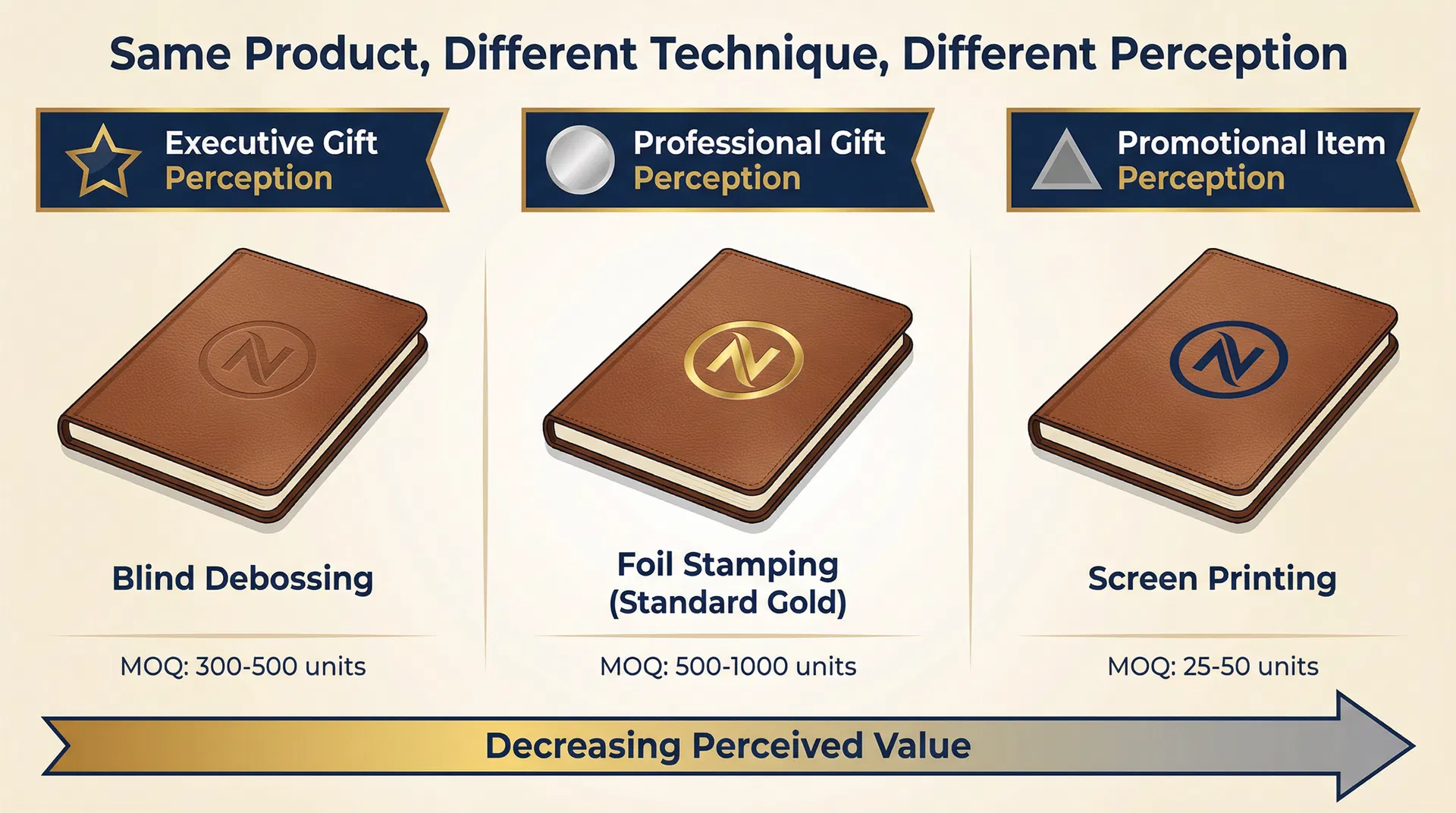
The reason this matters for corporate gift type selection is that the customisation technique is not a decorative afterthought. It is, in many cases, the entire difference between a gift that serves its business purpose and one that does not. Consider the difference between a leather notebook with a blind debossed logo and the same notebook with a screen-printed logo. Both are leather notebooks. Both carry the company's branding. Both fall within the same product category. But the recipient's perception of these two objects is fundamentally different. Blind debossing creates a tactile, understated impression that communicates premium quality and deliberate restraint. Screen printing creates a flat, visible logo that communicates promotional merchandise. The product is the same. The customisation technique determines whether the recipient categorises the gift as "executive" or "conference giveaway." And the customisation technique is determined not by the procurement team's preference, but by the order quantity's relationship to the technique's minimum production threshold.
The economics behind these thresholds are not arbitrary. Each customisation technique involves a different set of fixed costs that must be amortised across the order quantity. Blind debossing requires a custom brass or copper die, which costs between USD 80 and USD 250 depending on the logo complexity and die size. The die itself is a one-time cost, but the press setup—mounting the die, calibrating temperature and pressure for the specific leather or cover material, running test impressions to verify depth and clarity—adds two to three hours of machine time. For an order of 2,000 units, this setup cost distributes to roughly USD 0.15 per unit, which is invisible in the final price. For an order of 150 units, the same setup cost distributes to USD 1.50 to USD 2.00 per unit, which either inflates the quoted price beyond the client's budget or forces the factory to absorb a loss. Most factories resolve this by setting a minimum order quantity for debossing—typically 300 to 500 units—below which they either decline the technique or offer an alternative.
Foil stamping follows a similar logic but with higher fixed costs. Hot foil stamping requires both a custom die and a specific foil colour selection. Standard gold or silver foil is typically available from stock, but a custom Pantone-matched foil—which many brand guidelines require—must be ordered from the foil supplier with its own minimum purchase quantity, usually measured in linear metres. A single roll of custom-colour foil might produce enough material for 5,000 impressions, but the foil supplier's minimum order is one roll. If the client needs 200 notebooks with custom-colour foil stamping, the factory must either purchase an entire roll and absorb the waste, or inform the client that custom foil colour is not available at their quantity and offer standard gold or silver instead. The client, who selected foil stamping specifically because their brand colour is a distinctive teal or burgundy, now faces a choice between a generic metallic finish that does not match their brand identity or a different technique entirely.
Laser engraving on metal pens and desk accessories presents a different cost structure but the same fundamental constraint. The laser equipment itself has minimal per-unit setup cost—the artwork is loaded digitally, and the machine can switch between designs in minutes. This makes laser engraving one of the most accessible techniques at low quantities, with practical minimums as low as 25 to 50 units. However, the technique is limited to certain materials and surfaces. Laser engraving works well on anodised aluminium, stainless steel, and certain coated metals, but it produces inconsistent results on lacquered finishes, plated surfaces, and most plastics. A procurement team that selects a gold-plated pen for a VIP gift and assumes laser engraving will produce a clean result may discover that the engraving burns through the plating layer, exposing the base metal underneath. The technique is available at their quantity, but it is not compatible with their material specification. The interaction between technique and material creates a second layer of constraint that is even less visible than the quantity threshold.
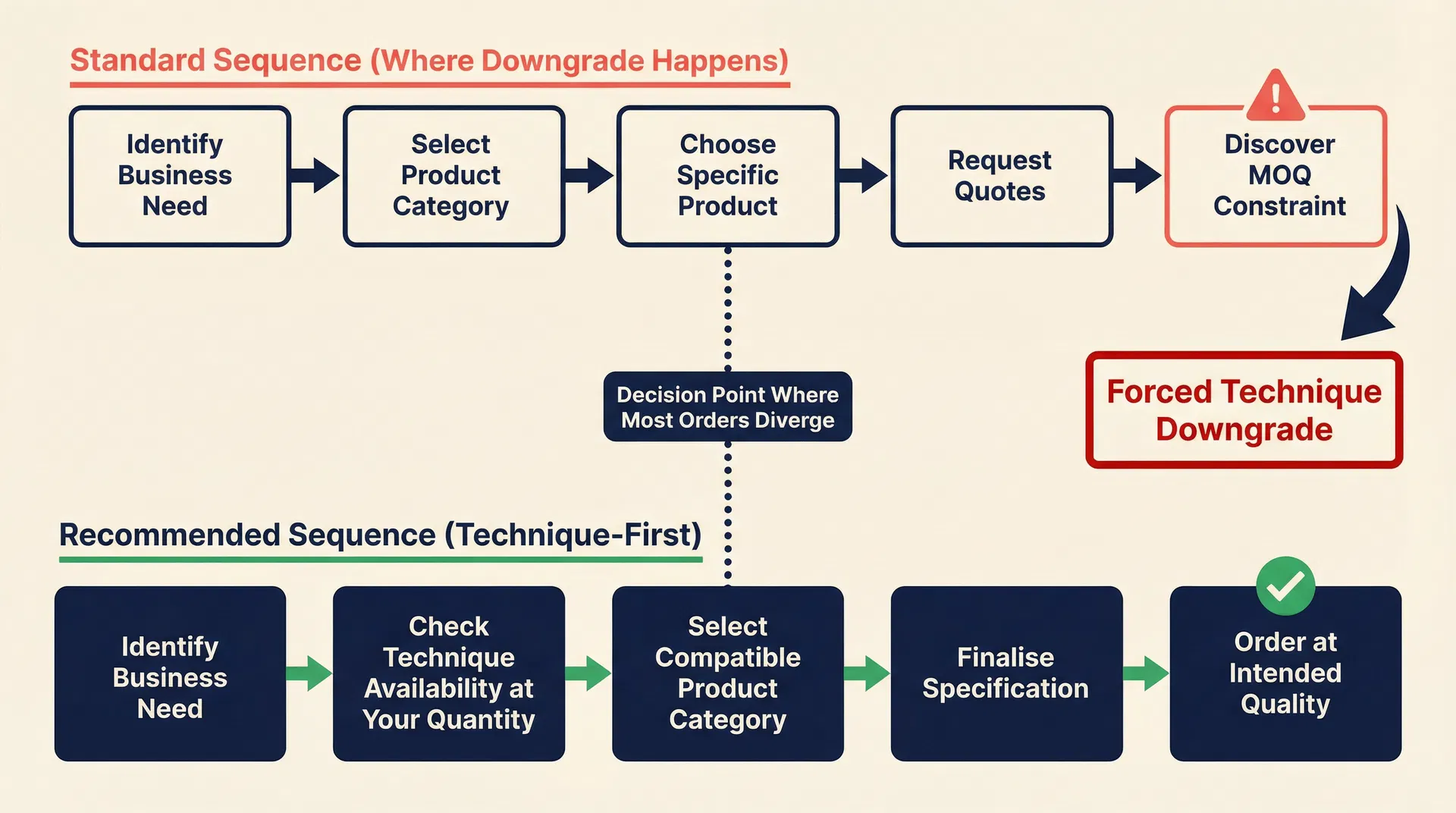
In practice, this is often where corporate gift decisions start to go wrong—not because the procurement team selected the wrong product category, but because the quantity-technique interaction was never evaluated as part of the selection process. The standard procurement workflow for corporate gifts follows a linear sequence: identify the business need, select the product category, choose a specific product, request quotes, approve the budget, and place the order. The customisation technique is typically treated as a specification detail that is finalised during the quoting phase, after the product category has already been selected and the budget has already been approved. By the time the factory explains that the requested technique requires a higher minimum quantity or a different material, the procurement team is locked into a product category and a budget that cannot accommodate the adjustment. The result is a forced downgrade—the same product, but with a lesser customisation technique that fundamentally changes the gift's positioning in the recipient's perception.
The scale of this problem is larger than most procurement teams realise because it affects not just individual orders but entire gifting programme structures. A company that segments its corporate gifts into three tiers—conference giveaways, client appreciation gifts, and VIP executive gifts—typically assigns different product categories and budget levels to each tier. The conference tier might use branded pens at AED 15 per unit. The client tier might use leather notebooks at AED 80 per unit. The VIP tier might use premium desk sets at AED 250 per unit. The budget differentials are clear. But if the conference tier orders 2,000 pens with full-colour UV printing, the client tier orders 300 notebooks with screen printing because the quantity is too low for debossing, and the VIP tier orders 50 desk sets with laser engraving on a material that does not engrave cleanly, the actual perceived quality gap between the tiers collapses. The conference giveaway pen, with its crisp full-colour branding, may actually present better than the client notebook with its flat screen-printed logo. The tiered structure that was designed to signal different relationship values instead signals inconsistent execution quality.
The practical solution to this problem is not to increase order quantities across the board—that creates inventory waste and storage costs that most gifting budgets cannot absorb. The solution is to invert the standard procurement sequence so that the customisation technique viability is evaluated before the product category is finalised. This means that instead of asking "What product should we give?" and then asking "How should we brand it?", the procurement team asks "At our required quantity, which customisation techniques are available, and which product categories support those techniques at the quality level our business need requires?" This is a fundamentally different question, and it produces fundamentally different outcomes. A procurement team that needs 150 VIP gifts and discovers that blind debossing requires a minimum of 300 units might choose to consolidate their VIP and client appreciation tiers into a single order of 400 units with debossing, rather than splitting into two separate orders where neither achieves the intended specification quality. Alternatively, they might select a product category where the preferred technique has a lower minimum—laser-engraved metal pens rather than debossed leather notebooks—because the technique, not the product, is what creates the perceived quality that the business occasion demands.
What makes this particularly consequential in the context of matching corporate gift types to specific business requirements is that the entire framework of gift type selection assumes that the selected product will be executed at its intended specification. A leather notebook is recommended for client retention because the material quality and customisation depth communicate ongoing investment in the relationship. A branded pen is recommended for conference networking because the lower unit cost allows broader distribution. These recommendations are sound at the category level. But they become misleading when the order quantity forces the leather notebook into a customisation technique that makes it look like a conference giveaway, or when the conference pen's quantity unlocks a customisation depth that exceeds what was intended for that tier. The minimum order quantity does not just affect the unit cost. It determines the ceiling of customisation quality that the gift can achieve—and that ceiling, not the product category, is what the recipient actually experiences.
I have seen this play out most acutely with presentation folders and document portfolios, which are among the most commonly specified corporate gift items for the UAE market. A well-executed presentation folder—genuine leather, blind debossed logo, custom interior pockets with a contrasting lining material—is a genuinely impressive business gift that recipients use daily and display prominently. But the "well-executed" version requires a minimum of 500 units to justify the die costs for the debossing, the material sourcing for the custom lining, and the hand-finishing labour for the interior assembly. At 100 to 200 units, the same product category is available, but the execution drops to PU leather with a heat-transferred logo and a standard nylon lining. The factory is not cutting corners. It is producing the best version of the product that the order quantity can economically support. But the procurement team, who approved the budget based on the 500-unit version they saw in the catalogue, receives a product that does not match their expectation—and more importantly, does not match the brand impression they intended to create. The gift type was correct. The business need was correctly identified. The failure occurred in the invisible space between the catalogue specification and the production minimum, where the order quantity silently determined which version of the product the recipient would actually receive.