Why Corporate Gift Materials That Pass Sample Approval Fail on the Recipient's Desk Within Ninety Days
Over the past six years, I have conducted material compliance assessments for branded stationery programmes across the UAE and wider Gulf region, and the single most persistent failure mode I encounter has nothing to do with production defects, shipping damage, or incorrect branding. It is a failure of material specification—specifically, the gap between how a corporate gift material performs on the day it is delivered and how it performs ninety days later, when the recipient has been using the notebook daily, carrying the pen in a jacket pocket, or opening the document folder in client meetings. The gift that looked and felt premium on Day One has begun to show surface cracking on the cover, ink fading on the barrel, or delamination at the folder spine. The brand impression it was designed to reinforce has quietly reversed. And the procurement team that approved the material specification has no visibility into this reversal, because their quality assessment ended at the point of delivery.
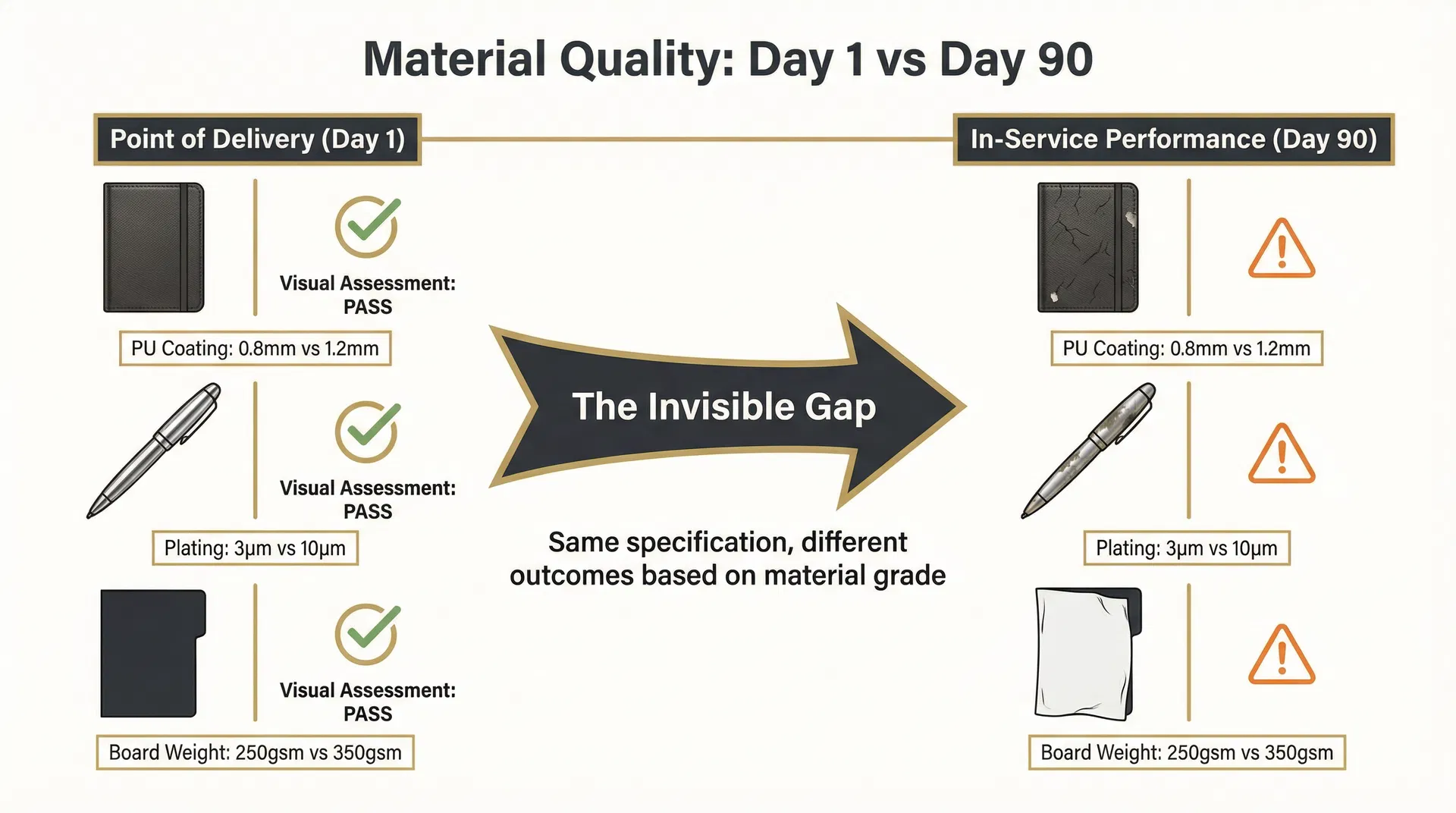
This is not a quality control failure in the conventional sense. The factory produced exactly what was specified. The materials passed incoming inspection. The finished goods matched the approved sample. Every checkpoint in the standard quality assurance process was satisfied. The failure occurred earlier—at the point where the procurement team evaluated the sample and concluded that the material was appropriate for the intended purpose. That evaluation was based on how the material looked and felt at a single moment in time, under controlled conditions, with no consideration of how the material would age under the conditions of actual use. In quality and compliance terms, this is the difference between point-of-delivery conformance and in-service performance, and it is a distinction that most corporate gift procurement processes do not make.
The materials most commonly affected are the ones most frequently specified in branded corporate stationery: synthetic leather covers for notebooks and portfolios, coated metal finishes on pens and desk accessories, and laminated or coated paper stocks used in presentation folders and gift boxes. Each of these materials can be manufactured to a range of quality grades, and the critical point is that the lower and higher grades are often visually indistinguishable at the point of delivery. A polyurethane leather cover produced with a 0.8mm coating thickness looks and feels nearly identical to one produced with a 1.2mm coating thickness when both are new. The difference emerges over time: the thinner coating begins to crack and peel after sixty to ninety days of regular handling, while the thicker coating maintains its surface integrity for twelve to eighteen months. A procurement team evaluating samples in a meeting room cannot detect this difference. A recipient using the notebook daily will experience it directly.
The same dynamic applies to metal pen finishes. Electroplated finishes on metal pens are specified by coating thickness, measured in microns. A pen with a 3-micron gold or chrome plating looks identical to one with a 10-micron plating when both leave the factory. The visual warmth, the reflective quality, the tactile smoothness—all indistinguishable in a sample evaluation. But a 3-micron plating on a pen that is handled daily, exposed to hand oils and perspiration, and repeatedly clipped into a pocket or bag will show visible wear—dulling, spotting, or base metal exposure—within eight to twelve weeks. A 10-micron plating on the same pen, subjected to the same conditions, will maintain its finish for well over a year. The cost difference between the two specifications is typically fifteen to twenty percent of the pen's unit price. The perception difference, once the lower-grade finish begins to degrade, is total. A pen with visible plating wear does not communicate "this company gave me a quality gift that I use every day." It communicates "this company gave me something cheap that is falling apart."
In practice, this is often where corporate gift material decisions start to be misjudged—not because procurement teams are careless, but because the evaluation framework they use is structurally misaligned with the product's actual use case. Consumer purchasing decisions are evaluated at the point of transaction: the buyer examines the product, assesses its quality, and makes a purchase decision based on what they see and feel in that moment. Corporate gift procurement borrows this same evaluation framework. The procurement team receives samples, assesses them visually and tactilely, compares them against the budget, and approves the specification. But a corporate gift is not a consumer purchase. It is a brand asset deployed into an uncontrolled environment for an extended period. The notebook sits on a desk for months. The pen travels in bags and pockets. The folder is opened and closed in meetings, exposed to varying temperatures and humidity levels. The material specification must account for this extended service life, and the evaluation process must include some mechanism for assessing durability—not just appearance.
The challenge is that durability assessment requires either technical knowledge that procurement teams typically do not possess, or testing protocols that add time and cost to the specification process. Assessing PU leather coating thickness requires a cross-section measurement with a calibrated gauge. Assessing electroplating thickness requires an X-ray fluorescence (XRF) reading or a destructive test. Assessing colour fastness on a dyed leather or coated surface requires a standardised rub test—typically a Crockmeter test conforming to ISO 105-X12—that measures how much colour transfers under controlled friction. These are not exotic tests. They are standard procedures in any material testing laboratory, and any competent factory can provide test certificates for them. But procurement teams rarely request them, because the tests address a dimension of quality—durability over time—that the procurement process does not formally evaluate.
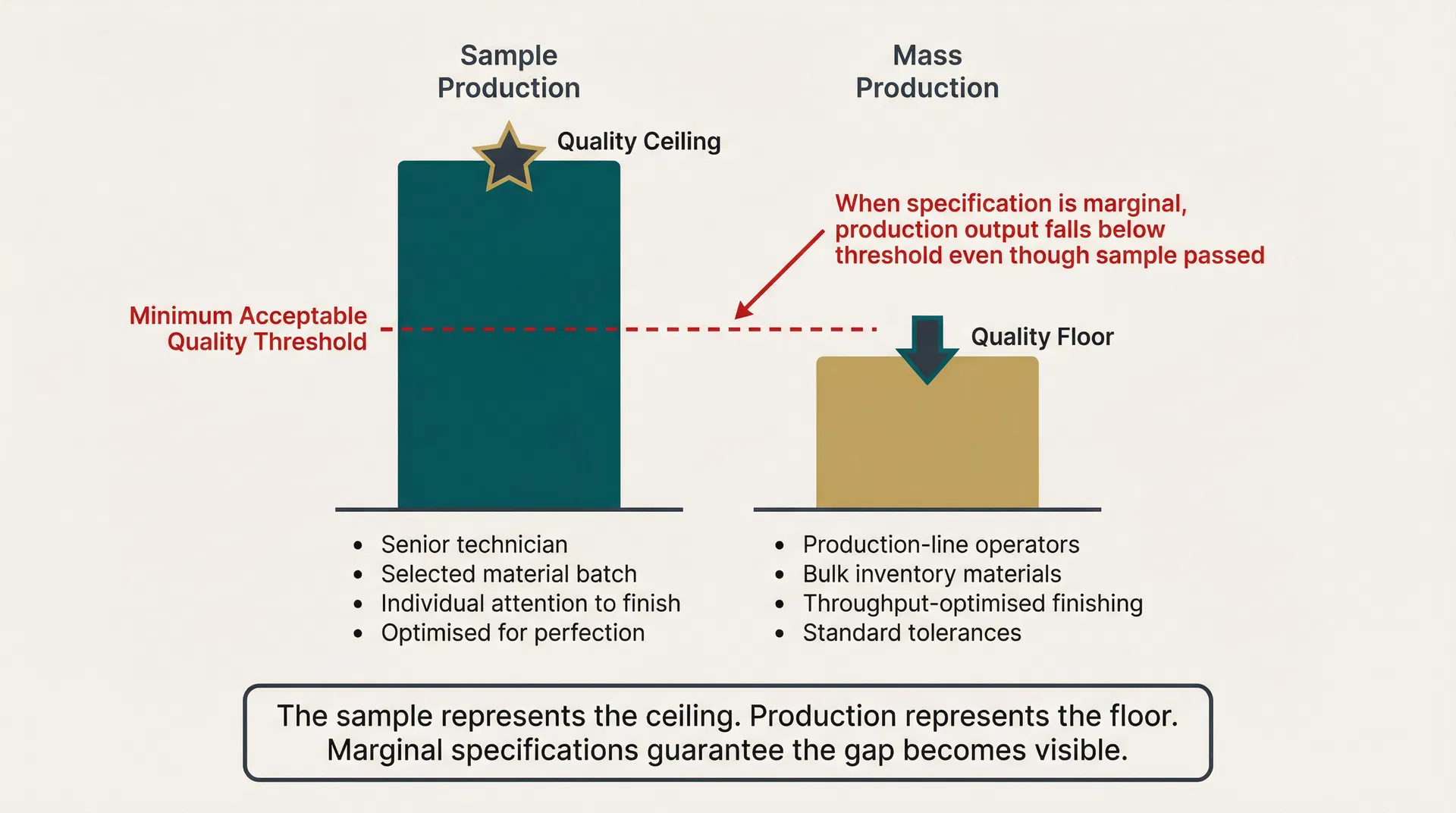
There is a second layer to this problem that compounds the first. The sample that the procurement team evaluates is not produced under the same conditions as the production run. This is not because factories deliberately produce superior samples to deceive buyers—though that does occasionally occur. It is because sample production and mass production are structurally different processes. A sample is typically produced by a senior technician or a dedicated sample room team, using materials selected specifically for the sample order, with individual attention to finishing details. Mass production uses production-line operators, materials drawn from bulk inventory, and finishing processes optimised for throughput rather than individual unit perfection. The result is a systematic quality differential between the sample and the production output. The sample represents the ceiling of what the specification can achieve. The production run represents the floor. If the specification itself is marginal—if the PU coating thickness is at the lower end of acceptable, or the plating thickness is just sufficient for the sample to look good—then the production run will fall below the threshold of acceptable quality even though every unit technically conforms to the specification.
I have seen this pattern repeat across dozens of corporate gift programmes in the Gulf region, and the consequences follow a predictable sequence. The procurement team approves a sample that looks and feels premium. The production run is delivered and distributed. For the first four to six weeks, the gifts perform as expected. Then the quality complaints begin—not from the procurement team, which has moved on to other projects, but from the relationship managers and account directors who gave the gifts to clients. A client mentions that the notebook cover is peeling. An executive notices that the pen finish has dulled. A sales director reports that a client returned a branded portfolio because the stitching had come apart. Each individual complaint is treated as an isolated defect. But the pattern is not about individual defects. It is about a material specification that was evaluated for Day One appearance and never assessed for Month Three performance.
The corrective approach is not complicated, but it requires a shift in how procurement teams think about material specification for corporate gifts. The specification must include not just what the material looks like, but how it will perform over the expected service life of the product. For branded notebooks and portfolios, this means specifying PU or genuine leather coating thickness, requesting abrasion resistance test results (typically Martindale or Taber tests), and requiring colour fastness certification. For metal pens and desk accessories, it means specifying minimum plating thickness in microns and requesting salt spray test results that demonstrate corrosion resistance over a defined period. For presentation folders and packaging, it means specifying paper weight in GSM, coating type, and fold endurance ratings. None of these specifications add significant cost to the product—they are standard parameters that any quality-oriented factory already measures internally. What they add is accountability: a documented standard against which the production output can be measured, and a basis for rejecting materials that meet the visual standard but fail the durability standard.
The connection between material specification and the broader question of selecting the right corporate gift for a particular business context is direct but frequently overlooked. A procurement team may invest considerable effort in choosing the right product category—deciding that a leather notebook is more appropriate than a pen set for a particular recipient tier, or that a desk accessory better suits a client retention programme than a conference giveaway. That category-level decision is important. But it is rendered meaningless if the material specification within the chosen category does not support the product's intended service life. A genuine leather notebook with a poorly specified thread weight will lose its stitching within months. A metal pen with inadequate plating will tarnish on the recipient's desk. A presentation folder with insufficient board weight will warp in the humidity of a Gulf summer. The gift type was correct. The material grade was not. And the recipient's experience of the gift—which is the only metric that ultimately matters—is determined by the material grade, not the product category.
What makes this particularly difficult to address within standard procurement frameworks is that the cost differential between adequate and inadequate material grades is often small enough to be invisible in a budget review. The difference between a 0.8mm and a 1.2mm PU coating on a notebook cover might add AED 2-4 to the unit cost. The difference between 3-micron and 10-micron plating on a pen might add AED 3-6. On an order of five hundred units, these differences amount to AED 1,000-3,000—a rounding error in most corporate gifting budgets. But the procurement team never sees this comparison, because the lower-grade specification is never presented as "lower-grade." It is presented as the standard specification, and the higher-grade option is presented as an upgrade that the procurement team must actively request and justify. The default, in other words, favours the specification that looks identical on Day One but fails on Day Ninety. And because procurement teams evaluate on Day One, the default prevails.
The practical implication for any organisation running a branded stationery programme—whether for client gifts, employee recognition, or conference distribution—is that the material specification conversation must happen before the sample is produced, not after. Once a sample has been produced and approved based on its visual and tactile qualities, it becomes extremely difficult to reopen the material specification without appearing to question the supplier's quality or the procurement team's judgement. The specification must be established as a contractual requirement at the quotation stage, with specific numerical parameters for the material properties that determine in-service performance. This shifts the evaluation from "does it look good?" to "does it meet the specification?"—and the specification, if properly written, already accounts for the durability requirements that visual evaluation cannot detect.