Sample Approval vs. First Production Batch Validation Timing Gap in Custom Stationery Procurement
When procurement teams receive sample approval from all stakeholders—marketing, legal, executive—the natural assumption is that production can begin immediately and proceed smoothly toward the agreed delivery date. The sample has been scrutinized, adjustments have been made, and everyone has signed off. In practice, this is often where customization process decisions start to be misjudged. What procurement interprets as "production ready" is actually "prototype validated," and the gap between these two states introduces a hidden delay that rarely appears in initial timeline projections.
The source of this misjudgment lies in how samples are produced versus how mass production operates. Samples for custom stationery—whether embossed notebooks, foil-stamped folders, or UV-printed gift sets—are typically hand-finished or produced in small batches under controlled conditions. Paper is selected from a single mill run, ink is mixed in small quantities with manual color matching, and embossing or foil application is adjusted by hand until the result matches the approved design. This level of control ensures the sample looks exactly as intended, but it does not reflect the realities of scaled manufacturing.
When production begins, suppliers shift to industrial processes optimized for speed and cost efficiency. Paper comes from bulk inventory that may span multiple mill batches, each with slight variations in brightness, texture, or absorbency. Ink is mixed in larger volumes using automated dispensing systems that introduce minor ratio drift due to temperature fluctuations or equipment calibration. Embossing presses are set to run continuously at higher speeds, which affects pressure consistency and depth precision. These are not quality failures—they are inherent characteristics of moving from prototype to production scale.
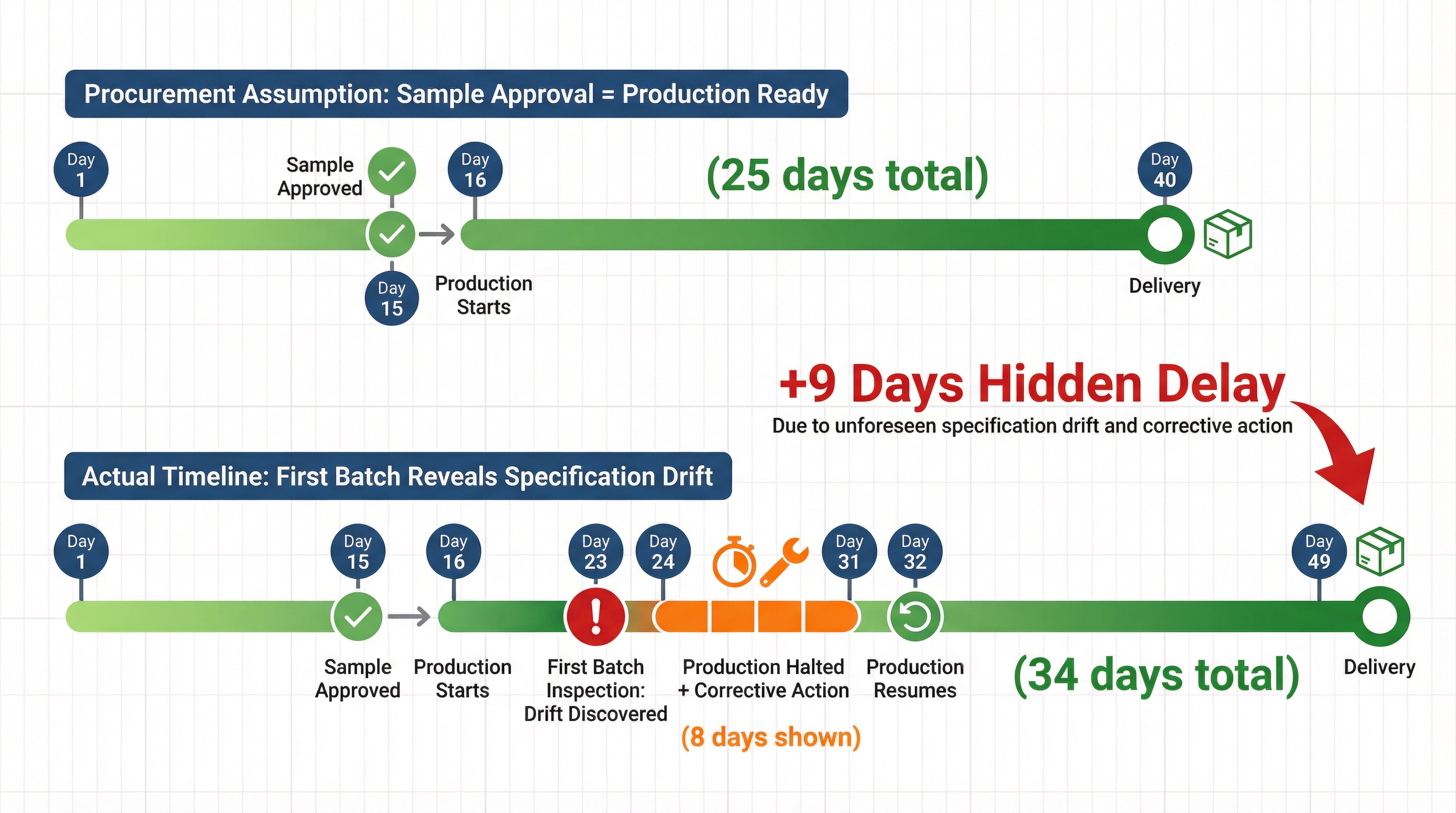
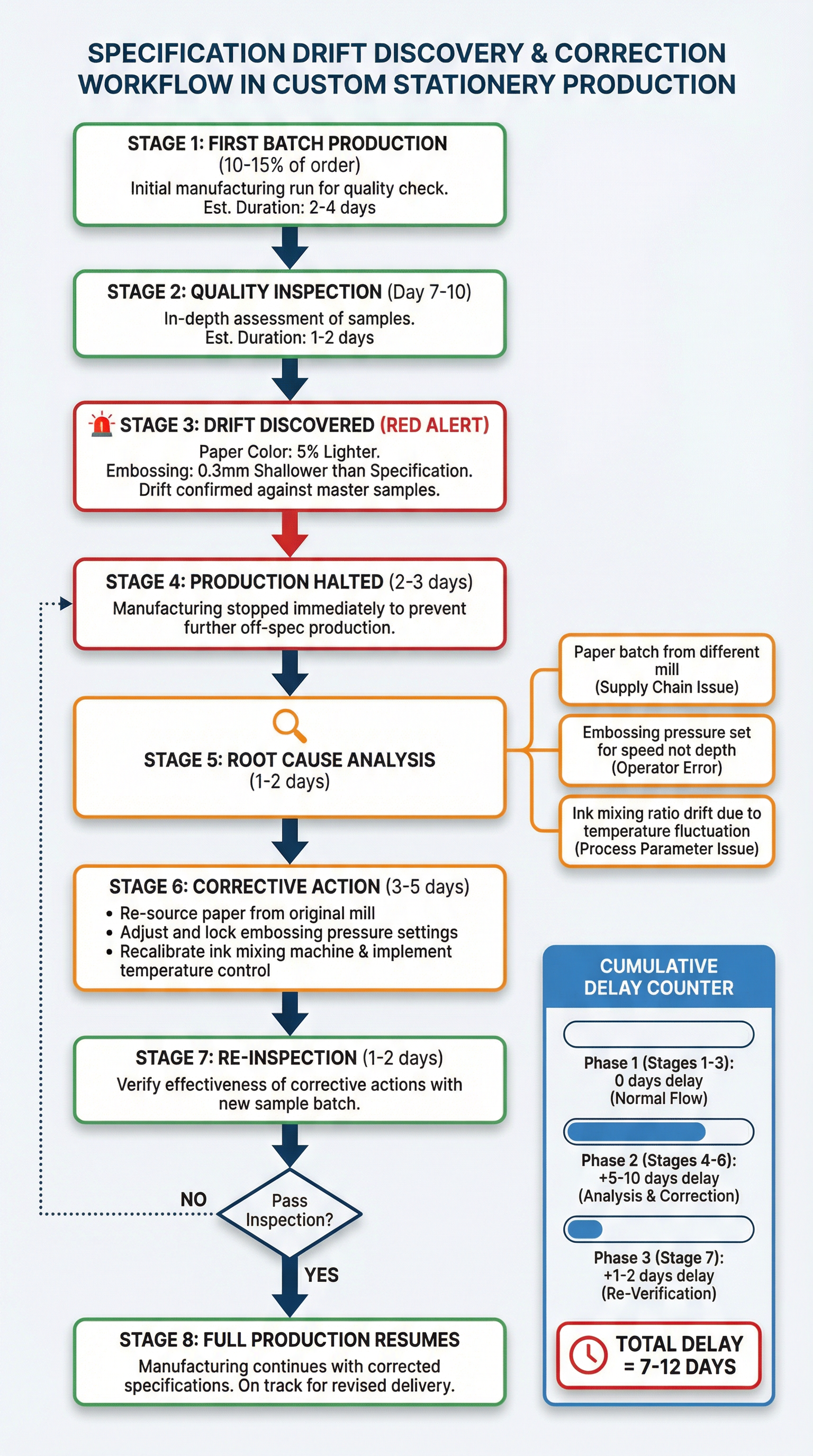
The critical misunderstanding is timing. Procurement teams often assume that once the sample is approved, the supplier will replicate it exactly across the full order. What actually happens is that the supplier produces a first batch—typically 10-15% of the total order—and submits it for inspection before scaling to full production. This first batch is where specification drift becomes visible. The paper may be 5% lighter in color than the approved sample because it came from a different mill batch. The embossing may be 0.3mm shallower because the press was calibrated for speed rather than depth. The foil adhesion may be weaker because the temperature setting was adjusted to prevent scorching at higher throughput.
These deviations are not discovered immediately. The first batch is produced over 2-4 days, then undergoes quality inspection that takes another 1-2 days. By the time procurement receives the inspection report—usually 7-10 days after production officially "started"—the assumption that production is progressing smoothly has already been baked into stakeholder expectations. The discovery that the first batch does not match the approved sample triggers a sequence of events that procurement did not anticipate: production is halted to prevent further off-spec output, a root cause analysis is conducted to identify which process parameters drifted, corrective actions are implemented (re-sourcing materials, adjusting machine settings, re-running test batches), and a re-inspection is performed to confirm the issue is resolved.
This sequence typically adds 7-12 days to the timeline. Production halt and root cause analysis take 2-3 days. Corrective action—such as sourcing paper from the original mill, recalibrating embossing pressure, or adjusting ink mixing ratios—takes another 3-5 days. Re-inspection to validate that the drift has been corrected takes 1-2 days. Only then does full-scale production resume. For a custom stationery order targeting a UAE corporate event like Ramadan gifting (March 10 - April 9, 2026) or National Day (December 2), a 9-day delay discovered midway through production can push delivery past the event date, rendering the entire order unusable.
The challenge is compounded by stakeholder re-engagement. After sample approval, marketing teams have moved on to campaign execution, legal teams have closed the compliance file, and executives have shifted focus to other priorities. When procurement discovers that the first production batch does not match the approved sample, the question becomes: is the deviation acceptable, or does it require correction? This is not a decision procurement can make unilaterally, especially for high-visibility corporate gifts. Marketing needs to assess whether the color shift affects brand perception. Legal needs to confirm that any text or logo changes still meet regulatory requirements. Executives need to weigh the cost of delay against the risk of distributing off-spec products.
Re-engaging these stakeholders mid-production is difficult. They are no longer in "approval mode" and may not have the original sample on hand for comparison. Procurement must circulate physical samples of the first batch, schedule review meetings, and manage conflicting opinions on whether the drift is material. In some cases, stakeholders accept the deviation to avoid delay. In others, they insist on correction, which extends the timeline further. Either way, the process introduces uncertainty that was not factored into the original delivery commitment.
The root cause of this misjudgment is not a lack of diligence—it is a structural misunderstanding of what sample approval represents. Procurement treats it as the final quality gate, after which production is simply a matter of replication. In reality, sample approval validates design intent, not production feasibility. The first production batch is the true validation checkpoint, and it occurs after production has already begun. This creates a timing gap that procurement does not account for when committing to delivery dates.
Experienced procurement teams address this by building first-batch validation into their timelines explicitly. Instead of assuming production will proceed smoothly from day one, they allocate 10-12 days for first-batch production, inspection, and potential corrective action before full-scale manufacturing begins. They communicate this to stakeholders upfront, framing it as a standard quality checkpoint rather than a contingency for problems. This shifts the conversation from "we discovered an issue" to "we are following our validation process," which reduces the perception of delay and maintains stakeholder confidence.
Another approach is to require suppliers to produce a pre-production batch using the same materials, equipment, and process settings planned for full-scale manufacturing. This batch is more expensive and time-consuming than a hand-finished sample, but it reveals specification drift before production officially begins. The trade-off is an additional 5-7 days in the pre-production phase, but this is preferable to discovering drift midway through production when corrective action is more disruptive and costly.
For UAE-based procurement, the seasonal concentration of corporate gifting demand makes this timing gap particularly consequential. Ramadan, National Day, and New Year account for the majority of annual custom stationery orders, and delivery windows are non-negotiable. A 9-day delay in March can mean the difference between gifts arriving before Ramadan begins and arriving after the holiday has ended. Procurement teams operating in this market cannot afford to treat sample approval as the final checkpoint—they must explicitly plan for first-batch validation and communicate this timeline to stakeholders from the outset.
The broader lesson is that customization process decisions are not linear. Sample approval does not automatically lead to production readiness, and production start does not guarantee smooth execution. The first production batch serves as a reality check, revealing whether the approved sample can be replicated at scale. Procurement teams that understand this distinction—and build it into their timelines—avoid the hidden delays and stakeholder re-engagement challenges that catch others by surprise. Those that do not often find themselves explaining why an order that was "approved and in production" is now delayed by two weeks, with no clear path to recovery.
Related Reading
For a comprehensive overview of the customization process and how to manage stakeholder expectations across all phases, see our guide on understanding the customization process for corporate stationery in the UAE.
Related Articles

Finishing Process Approval vs. Production Finishing Calibration Lock Timing Gap in Custom Stationery Procurement
Why procurement teams approve sample finishing quality expecting identical production results, but factories require 13-20 days of invisible calibration to translate manually-crafted sample finishing into automated production parameters, creating systematic delivery gaps through equipment translation, bulk foil procurement, and multi-trial parameter optimization.
Sample Approval vs. Bulk Material Procurement Lock Timing Gap in Custom Stationery Procurement
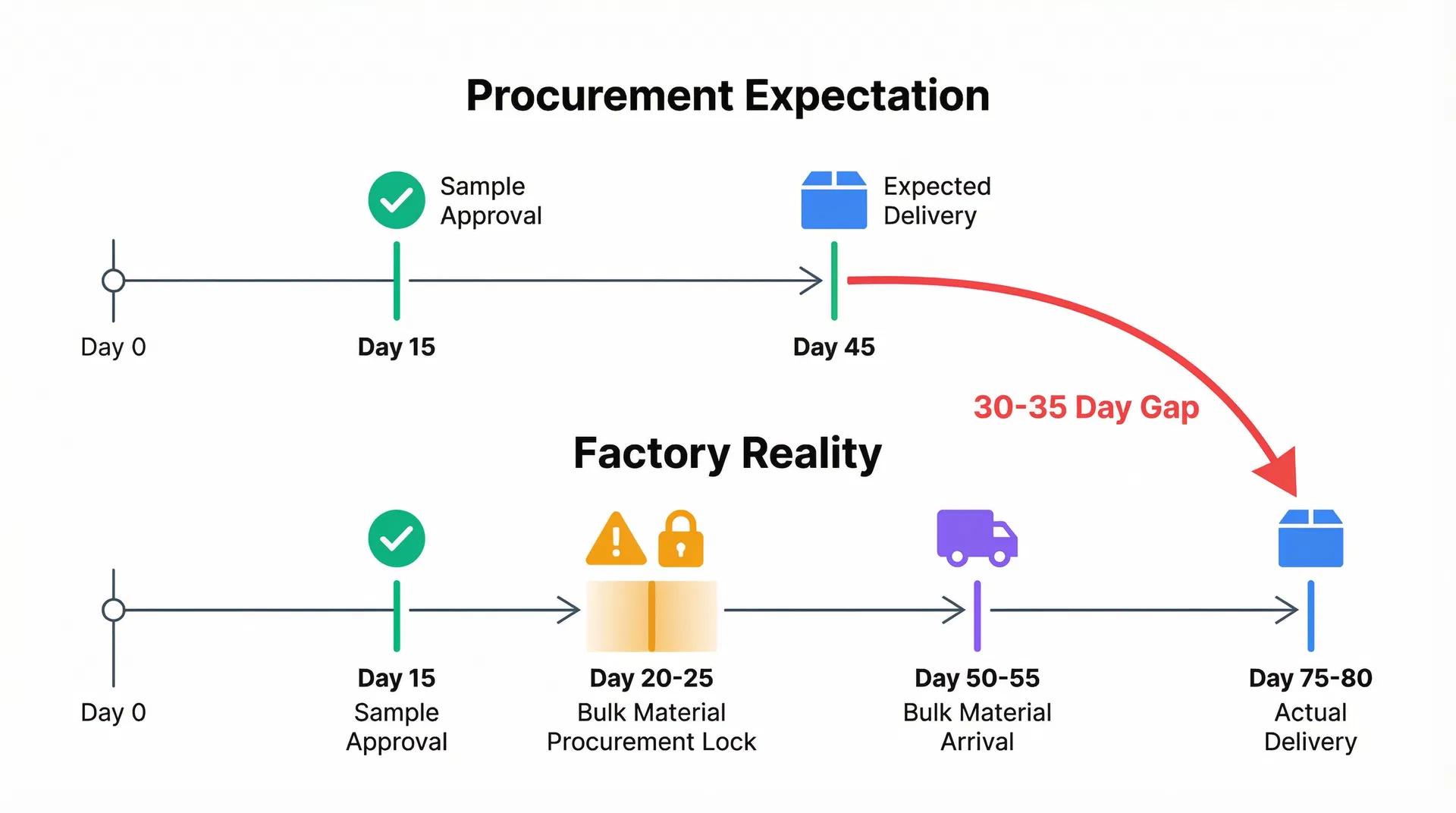
Why procurement teams approve samples expecting bulk production with identical materials, but factories lock bulk material procurement 5-10 days later using different suppliers with MOQ constraints, creating 30-35 day delivery gaps through invisible supplier switching and specification adjustments.